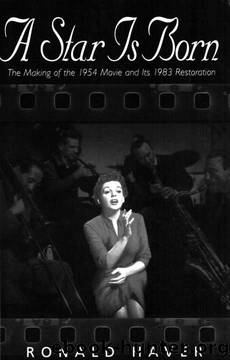
A Star Is Born: The Making of the 1954 Movie and Its 1983 Restoration by Ronald Haver
Author:Ronald Haver
Language: eng
Format: epub
Published: 2008-09-08T15:40:00+00:00
Men in dinner coats and women in elaborate evening dress crowd the tables to the farthest corners of the room. A large television screen is in evidence on which is being duplicated the same action as is taking place on the stage. At the moment, the entire room is applauding and a band is playing as Raymond Wallace, a youngish man, but not a youth, mounts the stage from the audience to be greeted by Susan Ettinger, last year's Oscar winner, who shakes hands with him and presents him, this year's male winner, with the Award statuette.
For the part of Miss Ettinger, Cukor had picked a young red-headed newcomer named Amanda Blake. Her part consisted solely of announcing the winner, presenting him the award, listening to his speech, and then exiting with him. It was what was known as a two-line bit. Richard Webb, playing the winner, had done featured roles in several Warner Bros. and Columbia B pictures; Rex Evans, playing the emcee, was a veteran character actor, while Steve Wyman, playing Nigel Peters, who presents Vicki with her Oscar, was a good-looking newcomer whose only previous work had been a tiny part in a Universal Western. With all of them Cukor worked quickly and carefully.
While the action was being worked out and coordinated with the camera crew, the special-effects camera crew was working out an ingenious split-screen effect that would take advantage of the huge expanse of CinemaScope screen in an innovative manner. As Vicki is presented with her award, the main camera would hold on a long shot of the entire room, with Vicki a tiny figure on the stage. On the right side of the screen, however, was the large television screen that Hart indicated, and on this would be repeated the same shot. But as the television camera crew was seen to dolly forward in the action of the scene, the figure on the television screen was enlarged until the entire television screen was filled with a close-up of Esther giving her acceptance speech. It was a unique and effective method of filling the large screen with the spectacle of the scene while simultaneously concentrating on the intimacy of the moment.
Because of the complexities of the sequence, the first shot was not taken until 12:40 p.m., and the shot was retaken seven times; the rest of the day was spent on the crowd's reaction shots. All the while, Mason waited for his scenes to be readied; he left at 4:30 without having worked in front of the camera. It was the same the next day: six shots were taken, none of which involved Norman.
But on the third day, Mason gave one of the most poignant and subtle performances in the entire film. As Vicki is making her acceptance speech, wrote Hart,
Download
This site does not store any files on its server. We only index and link to content provided by other sites. Please contact the content providers to delete copyright contents if any and email us, we'll remove relevant links or contents immediately.
The Great Music City by Andrea Baker(34019)
Aircraft Design of WWII: A Sketchbook by Lockheed Aircraft Corporation(32391)
Call Me by Your Name by André Aciman(20753)
The Secret History by Donna Tartt(19506)
The Art of Boudoir Photography: How to Create Stunning Photographs of Women by Christa Meola(18789)
Shoot Sexy by Ryan Armbrust(17873)
Plagued by Fire by Paul Hendrickson(17557)
Portrait Mastery in Black & White: Learn the Signature Style of a Legendary Photographer by Tim Kelly(17116)
Adobe Camera Raw For Digital Photographers Only by Rob Sheppard(17107)
Photographically Speaking: A Deeper Look at Creating Stronger Images (Eva Spring's Library) by David duChemin(16811)
Ready Player One by Cline Ernest(15174)
Pimp by Iceberg Slim(14820)
Bombshells: Glamour Girls of a Lifetime by Sullivan Steve(14241)
The Goal (Off-Campus #4) by Elle Kennedy(13994)
Art Nude Photography Explained: How to Photograph and Understand Great Art Nude Images by Simon Walden(13160)
Kathy Andrews Collection by Kathy Andrews(12124)
The Priory of the Orange Tree by Samantha Shannon(9393)
The remains of the day by Kazuo Ishiguro(9247)
Thirteen Reasons Why by Jay Asher(9155)
